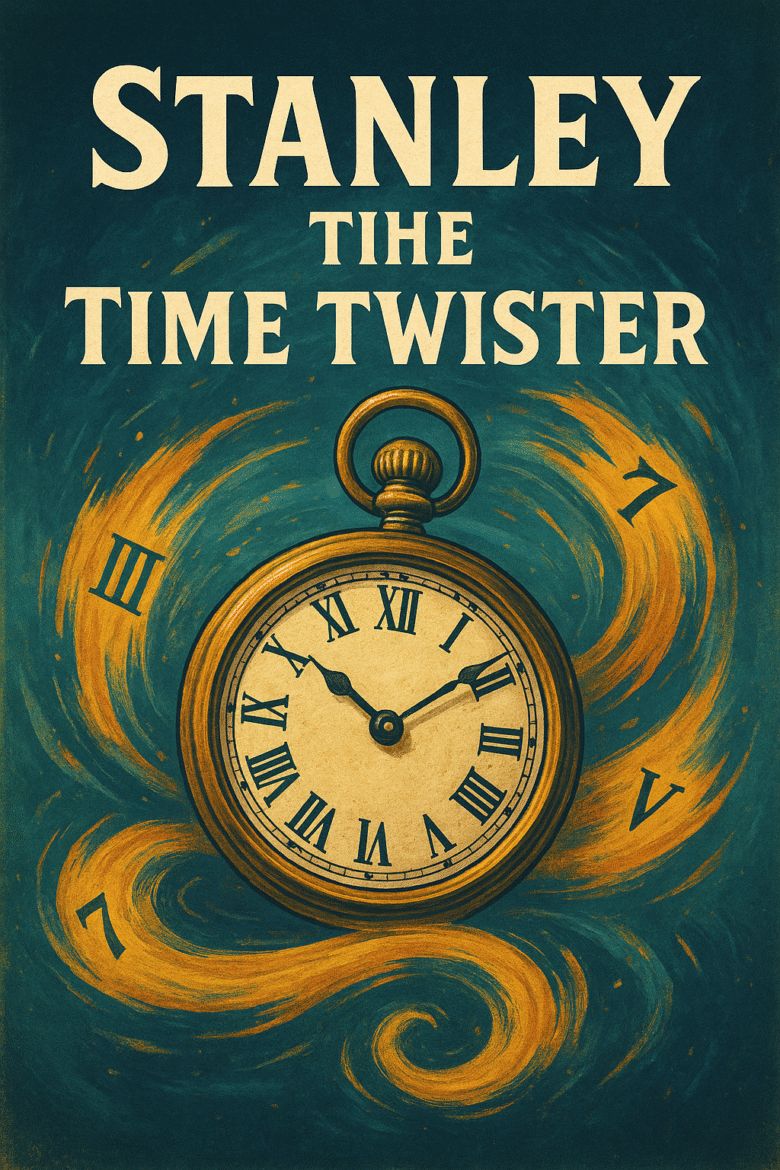
Chapter 1: The Morning That Shouldn’t Have Happened
Stanley Baxter wasn’t what you’d call a “morning person.”
He was more of a “morning hostage”—dragged out of his dreams every day at exactly 7:00 A.M. by an alarm clock that sounded like a dying robot.
This morning was no different.
BEEEEP! BEEEEP! BEEEEP!
Stanley groaned, rolled over, and slapped blindly at the clock. His hand missed and hit the nightstand instead.
“Ugh… five more minutes,” he mumbled, as if the alarm clock cared.
He reached again—half awake, half irritated—and then it happened.
A strange warmth pulsed from deep in his belly.
Not the “I ate too many chicken nuggets” kind of warmth—something electric, something alive.
It rushed up his chest, through his arm, and burst out of his fingertips right as they brushed the alarm clock.
The world flickered.
The room felt like it blinked.
Stanley opened his eyes fully for the first time.
The clock didn’t read 7:00 anymore.
It read 6:30 A.M.
He stared.
“Wait… what?”
He wasn’t that good at hitting the snooze button. Nobody was that good.
The house was quiet.
No footsteps in the hall.
No clattering dishes from the kitchen.
He shrugged, convinced he must’ve dreamed it.
Stanley rolled over, tugged the blanket up, and fell asleep instantly.
Thirty minutes later—
BEEEEP! BEEEEP! BEEEEP!
Same horrible robot scream.
Stanley’s eyes shot open.
He remembered.
He sat up fast and grabbed the clock again, on purpose this time.
He focused on that warm feeling—whatever it was—and it answered like it had been waiting for him.
Heat bloomed in his core, brighter, stronger.
His fingers tingled.
Time bent.
The numbers on the clock rolled backward like someone dialed life itself in reverse.
5:30 A.M.
Stanley blinked.
“Okay… okay, that’s not normal.”
He lay back down, but sleep was gone.
Wide awake now, heart thumping like he’d chugged three sodas.
He sat up.
He got dressed.
He even did the homework he’d skipped the night before—every last problem, even the boring ones.
By the time his alarm should have gone off, he was at his desk zipping his backpack.
BEEEEP! BEEEEP! BEEEEP!
7:00 A.M., right on schedule.
Stanley calmly reached over and turned it off like he’d been awake for hours.
Which, technically, he had—twice.
At 7:05 A.M., the door swung open.
His mother froze in the doorway like she’d walked in on a rare zoo exhibit.
“Stanley?” she asked slowly, eyes narrowing. “You’re… up?”
“Yep,” he said, trying to sound casual.
“You’re dressed.”
“Uh-huh.”
“You did your homework?”
Stanley lifted his backpack.
“Finished and packed.”
His mother blinked at him like she was checking for signs he might be possessed.
“Well,” she finally said, “I don’t know what’s gotten into you, but I like it.”
Stanley smiled.
If only she knew.
What had gotten into him wasn’t just motivation.
It was time itself.
Chapter 2: Breakfast of Confusion
The Baxter kitchen smelled like toast, orange juice, and the faint despair of children who wish it were Saturday. Stanley sat at the table, swinging his feet, trying his best to look normal. His stomach buzzed with that same warm energy from earlier, like he’d swallowed a small sun.
Sally shuffled in, hair sticking out in three different directions, clutching her favorite pink bowl. She dropped it on the table and grabbed the cereal box.
Stanley’s eyes sharpened.
Perfect target acquired.
She poured a neat pile of honey-colored loops into the bowl and drowned them in milk.
“Morning,” she muttered, half-conscious.
Stanley grinned. “Morning.”
Sally lifted her spoon, took one big bite, and chewed slowly.
Now.
Stanley placed two fingers on the table, focused on that warm spot in his core, and gave it a gentle push.
A ripple went through the world—silent, invisible, but unmistakable.
Sally froze, spoon halfway to her mouth.
Her cereal… was full again. Completely untouched.
She blinked.
Stanley bit the inside of his cheek to keep from laughing.
“Uh…” Sally looked at the clock. Looked at the bowl. “I just… I just ate some of this.”
“Maybe you dreamed it,” Stanley said, way too casual.
Sally narrowed her eyes at him, the way only a seven-year-old who suspects nonsense can. But she shrugged and took another spoonful.
Stanley waited until she swallowed—
Rewind.
The room pulsed again.
Sally stared at her bowl like it had personally insulted her.
“WHAT? Again? No. No no no.”
Stanley shrugged. “Maybe the cereal’s magic.”
She glared. “Cereal isn’t magic.”
“You don’t know that. Maybe it’s, like… regenerating. Like a starfish.”
“Stanley, cereal is not a starfish!”
He nodded gravely. “Says you.”
Sally jabbed her spoon into the bowl and took another determined bite. She chewed aggressively, like she was trying to prove the cereal wrong.
Swallow.
Stanley waited three seconds this time.
Just enough for her to relax.
Rewind.
The cereal refilled.
Sally screamed.
“MOOOOOM! MY CEREAL KEEPS UN-EATING ITSELF!”
Their mother, stirring oatmeal at the stove, didn’t even turn around.
“Sally, honey, cereal doesn’t un-eat itself.”
“It DOES! It really does! It’s doing it RIGHT NOW!”
Stanley picked up his own spoon and stirred his cereal innocently.
“Maybe you’re eating too fast,” he said.
“I AM NOT!” she snapped.
Stanley leaned over her bowl and peered inside. “Well, look at that. It is full again. Weird.”
Sally slapped her forehead. “Something is WRONG with this morning!”
“Probably,” Stanley said. “You look kinda glitchy.”
“WHAT DOES THAT EVEN MEAN!?”
He sat back, satisfied.
The prank had been perfect.
Until—
A sudden sharp sting pulsed behind Stanley’s left eye, like a tiny electric shock.
He winced.
The universe tapping him on the shoulder.
A quiet warning:
You play with time… time plays back.
He straightened, rubbed his forehead, and forced a smile as Sally inspected her cereal like it was a crime scene.
“Stanley?” she asked, suspicious now. “Are you doing something?”
He shook his head. “Me? Nope.”
But the warm power still hummed in his chest.
And his eye still throbbed with that strange, tiny ache.
The kind that promised this was only the beginning.
Chapter 3: The Cascade Begins
The cereal prank had been flawless—Sally confused, Stanley smug, and time itself bent like a pretzel.
Stanley wiped his grin off and finished his own breakfast like a gentleman who definitely didn’t just violate the fabric of reality.
But Sally…
Sally was fuming.
She kept staring at her bowl like it was plotting against her. Every few seconds she poked it, suspicious. She nibble-tested a single loop, chewed it slowly, and then checked the bowl again.
By the time she finally ate three actual bites, the clock was already pushing 7:30.
“Come on, kids!” Mom called. “We’re late!”
Strike One.
The schedule was already off by two minutes.
Sally grabbed her backpack—except she forgot to zip it shut in her confusion. She trotted to the car, and half her crayons and a worksheet fell out behind her like a sad breadcrumb trail.
Stanley watched.
He knew he could rewind and help her.
He chose… not to.
Strike Two.
Sally’s forgotten homework sat on the counter, face-up, innocent, abandoned.
Mom buckled in, glanced back, and gasped.
“SALLY! Your homework!”
Sally shrieked. “I—I thought I grabbed it! The cereal messed me up!”
Mom shot Stanley a look.
He almost choked. She suspects.
But only in the “older brother probably antagonized her again” sort of way.
Mom threw the car into reverse, muttering something about “mornings testing her patience.” They drove back to the house, grabbed the homework, then pulled out again.
But now—
They hit it.
The tractor.
Some ancient steel beast puttering along the road at approximately the speed of death.
“Of course,” Mom sighed. “Of course this would happen today.”
Stanley sank into his seat.
This was the universe’s handwriting, clear as day: You pushed time. Time pushes back.
The tractor turned a five-minute drive into ten.
Ten into twelve.
Twelve into Stanley looking at the clock and realizing horror:
They’d arrive after the bell.
By the time they pulled up to school, the yard was empty except for Mrs. Dalrymple—the Vice Principal—standing like a sentry with a clipboard.
She did not smile.
“Running late, are we?” she said.
Stanley tried to think of a lie.
Sally spoke first.
“My cereal time-traveled!”
Mrs. Dalrymple blinked once, slowly.
“That seems… unlikely.”
Mom stammered something about a rough morning.
But the damage was done.
Stanley and Sally were escorted inside with those tiny, humiliating Late Arrival slips clutched in their hands.
Strike Three.
Stanley got his tick in the attendance ledger.
And it just kept coming.
They reached the classroom a minute into a surprise pop quiz—one Stanley would’ve avoided entirely if he hadn’t rewound time to prank his sister.
Mrs. Tiller didn’t even look up as she handed them test papers.
“Find a seat. Start immediately.”
Stanley slid into his chair, glaring down at his blank page.
Ten math problems.
No notes.
Timed.
He closed his eyes.
All because he rewound breakfast.
All because he couldn’t resist messing with Sally.
He sighed, grabbed his pencil, and accepted his fate.
Somewhere in the school, Sally was probably still ranting about cereal physics.
And the universe, smug as always, whispered:
You play games with time…
and time plays them harder.
Chapter 4: The Mind-Reading Misfire
Lunch recess at Cedar Ridge Elementary always sounded the same—
running feet, kids yelling rules nobody followed, and those metal swings squealing like tortured seagulls.
Stanley liked it out here. Lots of noise.
Lots of cover.
Lots of opportunities.
He spotted Bernard sitting on the jungle gym, legs dangling, waving Stanley over with the enthusiasm of a kid who’d just discovered something very important.
“Stanley! Stanley!” Bernard called. “GUESS WHAT—”
Normally, Stanley would sigh, say “What?” and let Bernard ramble on for ten minutes about baseball stats, players, and whatever weird trivia lived rent-free in his fourth-grade brain.
But today…
Stanley felt bold.
Bernard inhaled to continue.
“Guess what happened next in the Blue Jays game last night—”
Stanley closed his eyes, dialed back a few seconds, rewound just enough to hear Bernard start the sentence again.
He opened them, grinning like a fox in a henhouse.
Bernard started again:
“Guess what hap—”
Stanley cut him off, perfectly timed.
“The shortstop missed the ground ball and everybody booed,” he said casually.
Bernard stared.
“Uh… yeah. That’s exactly what—how did you—?”
Stanley shrugged, trying to play it cool. “Lucky guess.”
Bernard squinted. “Okay well… GUESS WHAT else happened?”
Rewind. Replay.
Stanley interrupted again.
“Vladdy Jr. struck out in the eighth and you yelled at the TV so loud your dad told you to go outside.”
Bernard’s jaw dropped.
“That… that’s literally what I was about to say.”
Stanley smirked.
“I know.”
Bernard blinked. “Wait—since when do you watch the Blue Jays?”
Stanley froze.
He didn’t.
He couldn’t even name their mascot.
His mouth opened, but his brain provided exactly zero useful words.
Bernard’s expression soured.
“Are you making fun of me?” he asked flatly. “Is this, like… a joke?”
“No! I’m not—”
But Bernard held up a hand.
“No, dude. Seriously. If you don’t like baseball, just say you don’t like baseball. Don’t pretend you know everything I’m gonna say.”
Stanley’s stomach dropped.
“That’s not what I—”
Bernard shook his head and slid off the jungle gym.
“You know what? Never mind. I’m going to go play catch with Billy. At least he doesn’t act like a mind-reading robot.”
Stanley watched him walk away, each step a little heavier than the last.
The playground noise carried on around him—kids yelling, laughing, running—but suddenly it felt very far away.
Stanley sat alone on the bar, staring at his hands.
The power still hummed inside him like a secret engine.
But the engine didn’t feel exciting now.
It felt… cold.
He’d meant it as a harmless trick.
Just a little fun.
But Bernard thought he was mocking him.
The one kid who always invited him to hang out, always shared his lunch snacks, always talked to him even when Stanley wasn’t listening.
Now Bernard wouldn’t even look at him.
Stanley rubbed his forehead, where the earlier headache still throbbed slightly.
He whispered, “I was just trying to have fun…”
But the universe didn’t care.
Because time wasn’t a toy.
And every trick—no matter how clever—had a cost.
Chapter 5: The Loneliest Kid on the Playground
The playground roared around Stanley—
kids laughing, shouting, sprinting across the field like sugar-fueled meteors—
but it all washed past him like he was sitting behind an invisible wall.
Bernard had joined Billy near the back fence.
They were tossing a ball back and forth, laughing at some inside joke Stanley couldn’t hear.
He usually would’ve jogged over, joined in, stolen the ball once or twice.
But today he just watched.
Bernard never even glanced his way.
Stanley’s fingers curled into the gravel beneath him.
He dug a little hole absently, like he was trying to bury that sick feeling in his stomach.
The warm energy inside him—his time-bending power—felt dim now.
Like someone had thrown a blanket over it.
For the first time since sunrise, he didn’t want to use it.
Didn’t want to rewind.
Didn’t want to fix anything.
He just wanted Bernard to talk to him again.
The recess bell shrieked overhead.
Kids groaned, shuffled, stomped, and sprinted toward the building.
Everyone moved in noisy, messy clusters—friends grabbing each other’s backpacks, kids joking, arguing, pushing, shoving.
Stanley remained still for a beat longer.
He felt… disconnected.
Like the schoolyard was a movie and he was just watching it instead of living it.
He stood slowly, brushing gravel off his hands.
His legs felt heavier than they should have, as if every step had a cost.
He walked toward the double doors alone.
No Bernard beside him.
No Billy shoving him playfully.
No Sally tugging on his sleeve.
Just Stanley.
And the echo of his own mistake.
Kids streamed past him, chatting about the lunch menu, the dodgeball game, who cheated who, who kicked who, who ran faster than who.
Stanley heard none of it.
He pushed the door open and shuffled down the hall toward his next class.
The fluorescent lights buzzed overhead.
His sneakers squeaked faintly on the linoleum.
He kept his eyes on the floor.
He usually liked the afternoons—science class, experiments, fun stuff.
But today even that felt dim.
As he reached the doorway, he realized something:
Time travel didn’t just change events.
It changed people.
And right now, it had changed his best friend.
He slipped into his seat, slumped down, and stared at his empty desk.
For the first time, Stanley Baxter—fourth grader, early riser, cereal prankster, accidental time wizard—felt unmistakably, painfully small.
And terribly alone.
Chapter 6: The Proof in One Minute
The final bell rang, and the fourth-graders flooded out like someone kicked over a bucket of noisy puppies. Stanley stepped onto the sidewalk and scanned the crowd for Bernard and Billy.
There they were.
Walking ahead of him.
Not waiting.
Not waving.
Not even looking back.
Stanley felt that same sinking feeling he’d had on the playground. He picked up his pace, jogging slightly until he caught up with them.
“Hey—hey, guys… wait up.”
Bernard didn’t answer.
Billy kept his eyes straight ahead.
It was Billy who finally broke the silence.
“Why were you being weird today?”
Stanley swallowed.
“I wasn’t trying to be weird.”
Bernard kicked a pebble along the curb.
“You weren’t listening. You were acting like… like you already knew everything I was gonna say.”
Stanley slowed his steps. “I didn’t mean to hurt your feelings. I’m really sorry.”
Bernard’s shoulders dropped a little. He wasn’t mad anymore—just confused.
But Billy wasn’t letting him off that easy.
“Stanley,” Billy said, turning to face him, “if we’re really best friends, you gotta tell us the truth. All of it. Something’s up. You’re not acting normal.”
Stanley hesitated.
The secret pulsed inside him—warm, electric, impossible.
He took a deep breath.
“Okay… okay. I’ll tell you.”
Both boys stopped walking.
Stanley looked at the sidewalk, then back at his friends.
“I can… move time. Like… rewind it. A little.”
Silence.
Bernard blinked at him.
Billy blinked harder.
Then both boys burst out laughing.
“Oh come on,” Billy said. “Time travel? Really?”
Bernard smirked. “What’s next, you can fly?”
Stanley’s face burned.
He’d expected disbelief, but not this hard.
“Guys, I’m serious.”
They shook their heads and kept walking.
“Prove it,” Billy said finally.
“Yeah,” Bernard added. “If you can really do it, show us something. Something real.”
Stanley opened his mouth—then stopped.
He didn’t know how to prove it without messing things up again. Without consequences.
They reached the big intersection near Maple Street—the one with the long stoplight and the impatient drivers.
The boys stood at the curb, waiting.
Stanley felt the hair on his arms prickle.
A strange pressure.
Something in the air shifting.
He looked to the right just as a silver sedan sped toward the red light.
Too fast.
Stanley’s eyes widened.
A pickup entered the intersection.
The sedan blew the red light—
CRASH!
The sound echoed through the town. Tires screeched. People yelled.
Bernard jumped. “Whoa!”
Billy grabbed Stanley’s arm. “Dude, did you just—?!”
Stanley shook his head.
“No. But that… that gave me an idea.”
He closed his eyes, touched the warmth in his core, and pulled.
The world rippled backward—
a silent rewind, a breath pulled in reverse—
And suddenly…
They were back on the sidewalk.
One minute earlier.
The sedan was still approaching.
The truck hadn’t even entered the intersection yet.
Everything was reset.
Stanley pointed at the road, voice firm.
“In exactly forty seconds, that silver car is going to run the red light and hit the pickup.”
Bernard’s mouth fell open.
Billy stopped breathing.
They watched.
Thirty seconds.
Twenty.
Ten.
The sedan never slowed.
CRASH!
The same explosion of noise.
The same skidding tires.
The same shouts.
Billy staggered backward.
Bernard grabbed Stanley’s shirt.
“You… you knew,” Bernard whispered.
Stanley nodded slowly.
“I didn’t change anything. I just watched. When I don’t interfere… nothing bad happens.”
The boys stared at him, no laughter now—only awe, fear, and something like respect.
Billy swallowed hard.
“Stanley… this is real. You’re… you’re serious.”
Stanley looked at both of them—two boys who’d been there for him since kindergarten.
“Yeah. I told you. I’m not messing around. And I need you guys to keep it a secret. Please.”
Bernard put his hand on Stanley’s shoulder.
“You’re our friend. We won’t tell anyone.”
Billy nodded. “Yeah. Scout’s honor. Or… whatever honor this counts as.”
“Time-travel honor,” Bernard said.
Stanley cracked a small smile.
The first real one since lunch.
“Thanks.”
They kept walking—together this time—three boys bound by the biggest, strangest secret a fourth-grader could ever carry.
And for the first time all day, Stanley didn’t feel alone.
Chapter 7: The $8.50 Investment Empire
The next morning, Stanley arrived at school with a little more confidence in his step.
A good night’s sleep, a calmer mind, and two best friends who now believed him?
Life was looking up.
At least until recess.
Bernard pulled Stanley and Billy behind the equipment shed like they were planning a jailbreak.
“Okay,” Bernard said, hands on hips, “we need to talk business.”
Stanley groaned.
“That’s never a good sentence coming from you.”
“No, no—listen!” Bernard’s eyes sparkled. “You know the Blue Jays? We could make a fortune betting on baseball games! Stanley just needs to go forward in time, check the scores, come back, and BOOM—we’re rich!”
Billy nodded vigorously. “Like, millionaire rich.”
Stanley blinked. “Guys… we’re in fourth grade. We don’t have money to bet with.”
Bernard grinned and proudly held out his hand.
On his palm sat a pile of coins and crumpled bills.
“Between the three of us, we have eight dollars and fifty cents.”
Stanley stared. “Wow… an empire.”
“Hey,” Billy said, “it’s a start.”
They hustled to the computer lab during free time and hopped onto a sports betting website—only to find a giant block of text.
Billy read it aloud dramatically:
“‘You must be eighteen or older to create an account.’”
Bernard’s shoulders slumped. “What? That’s not fair.”
“Yeah,” Stanley said. “It’s almost like they knew nine-year-olds would try this.”
Bernard frowned hard enough to bend space-time.
“Well what do we do now?”
Billy snapped his fingers. “Crypto!”
Stanley tilted his head. “Crypto… like the superhero dog?”
“No!” Billy groaned. “Crypto currency. My dad talks about it all the time. He says people make crazy money on it. And guess what—there’s a new coin launching today. Comet Coin.”
Bernard’s eyes went wide. “Dude. That sounds awesome.”
“And,” Billy said, lowering his voice, “you can buy it with cash at the coin counter machine at the MartLand SuperCenter.”
Stanley rubbed the back of his neck.
“This… doesn’t sound legal.”
Billy shrugged. “My dad said kids buy gift cards with cash all the time. Same thing.”
Bernard clapped Stanley on the back. “C’mon! Just go one month ahead and check the price. Easy!”
Stanley hesitated.
This didn’t feel like cheating.
He wasn’t changing anything—just looking.
He closed his eyes.
The warm energy rose.
His stomach tightened.
The world tipped—
And he was gone.
One Month Later (and Thirty Seconds in Real Time)
Stanley blinked into existence beside the same computer, the same boys, the same shed.
He checked his phone’s clock:
4 weeks had passed.
His heart raced as he navigated back to the crypto site.
Comet Coin Value: $1.00 → $10.00
Ten.
Times.
He gasped.
Their $8.50 would become $85.00.
In one month.
He almost laughed.
No consequences.
No changes.
Just knowledge.
He pulled himself back to the present.
Back in Real Time
Billy and Bernard stared at him, barely breathing.
“Well?” Billy whispered.
Stanley smiled—big, proud, maybe a little too confident.
“It goes up ten times.”
The boys froze.
Bernard whispered reverently, “We’re gonna be… loaded.”
They high-fived so loudly a nearby teacher shouted at them to stop “making racket.”
Billy practically danced.
“We invest today. After school. Coin hopper machine. Comet Coin, here we come!”
Stanley felt a light flutter of pride.
No danger.
No ripple.
No universe smackdown.
He wasn’t changing anything.
Just using information that already existed.
What harm could it possibly do?
Chapter 8: The Investment Operation
After school, the boys marched into MartLand SuperCenter like three miniature businessmen with a mission.
Bernard carried the pooled money—three dollar bills, a handful of coins, and an impressive amount of lint.
Billy kept checking over his shoulder like they were smuggling state secrets.
Stanley just tried to ignore the nervous knot in his chest.
They reached the beefy coin-counting machine—big, loud, and slightly sticky on the buttons.
“Okay,” Billy said in his official voice, “let’s do this.”
Bernard fed the money into the hopper.
The machine clanked, whirred, clattered, and processed their empire.
Finally—it spit out a small slip of paper.
A receipt.
And on it—
A code.
A real crypto purchase code.
Bernard grabbed it like it was the Declaration of Independence.
“DUDES. WE ARE INVESTORS NOW.”
Billy pumped his fist.
Stanley forced a smile.
They speed-walked, half-running, all the way to Stanley’s house.
At Stanley’s Room: Their First Wallet
Stanley pulled out his laptop, the one he usually used for Minecraft and homework he didn’t want to do.
The boys huddled around as he created a digital wallet.
New wallet name: “BB&S Fund”
(Bernard, Billy & Stanley)
They entered the code.
And like magic—the balance appeared.
$8.50 worth of Comet Coin.
Bernard let out a satisfied grunt.
Billy whispered, “We are so getting a game system.”
Stanley didn’t say anything.
They executed the trade.
The screen flickered.
A tiny green check mark appeared.
Transaction complete.
Bernard high-fived Billy.
Billy high-fived Stanley.
Stanley’s hand felt cold.
The boys fell into a frenzy—talking about what they’d buy, what games they’d play, where they’d put the console, whether they should decorate the controllers.
But Stanley kept glancing at the clock.
And at his hands.
That night, the worry followed him into bed.
The same thought circled his mind like it had claws:
Every action has a cost.
Even the ones you think are harmless.
He rolled over, stared at the wall, and made a decision.
He would check again.
One Year in the Future (and Ten Seconds Later)
The world shifted with a familiar jolt.
Stanley climbed out of bed in the silent, future version of his room and opened the laptop.
The Comet Coin chart loaded slowly… agonizingly… like the universe wanted him to sweat.
The price blinked onto the screen:
$4.00
Stanley’s stomach sank.
Their investment would be cut in half.
But then he clicked the chart.
And his eyes widened.
A spike.
A huge spike.
Exactly 42 days from the day they bought it.
That spike hit x19 value.
Their $8.50 would become—
$161.50
He felt his heart pound.
This wasn’t gambling.
This was seeing the weather forecast.
And the future was sunny with a chance of profit.
He closed the laptop, pulled the warmth back into his core, and returned home to his normal timeline.
He slid back into bed.
And slept like a rock.
The Next Morning: A Pact Sealed
At school, Stanley pulled the boys aside behind the bike racks.
“I checked again,” he said softly.
“In a year it drops. But… 42 days from now? It’s worth nineteen times as much.”
Bernard and Billy stared at him with huge eyes.
Billy whispered, “Dude. We’re geniuses.”
Bernard shook his head. “No. Stanley’s the genius. We’re the business guys.”
Stanley smiled, embarrassed.
But not uneasy this time.
This wasn’t changing the past.
This wasn’t messing with events.
This was using knowledge.
Knowledge that already existed.
The three boys stood together in a quiet little triangle.
A bond formed—not the kind from lunchtime arguments or shared Pokémon cards.
A real bond.
A secret.
A power.
A plan.
And an investment they actually all believed in.
Bernard finally said, “We keep supporting each other, right? No matter what?”
Billy nodded.
“Best friends don’t break secrets.”
Stanley grinned.
“Best friends don’t break time, either.”
They laughed.
And for a moment, everything felt perfect.
Chapter 9: The Woman Who Shouldn’t Have Known
Three days after the boys made their brilliant crypto plan, school let out like any other day.
Warm sun.
Buzzing chatter.
Backpacks bouncing.
Stanley, Bernard, and Billy were halfway down Oak Street when Billy froze and whispered, “Guys… don’t look now.”
Naturally, all three boys turned immediately.
There, half a block behind them, walked old Mrs. Smith—the cat lady.
Everyone in their neighborhood knew Mrs. Smith.
She lived in the giant Victorian house with peeling paint and curtains that always seemed to move by themselves.
She bought every fundraising item the boys ever sold—chocolate bars, candles, wrapping paper, weird decorative soaps.
But she never left her house.
Ever.
Except today.
And she was following them.
Stanley squinted.
Mrs. Smith pretended to read a telephone pole flyer upside-down.
Bernard whispered, “Dude… she’s totally following us.”
Billy nodded. “Cats have, like… powers. Maybe she does too.”
“Billy.”
Stanley frowned.
“That makes zero sense.”
“That’s how you know it’s true,” Billy whispered.
Mrs. Smith took two more steps toward them.
The boys jolted.
“Okay—scatter!” Bernard hissed.
They broke into three directions like panicking pigeons—Bernard down Maple Street, Billy straight toward the corner store, Stanley across the street toward a backyard fence.
The plan: Run homeward, pretend to split up, then reconvene at the park playground a block away.
They sprinted.
They ducked.
They dodged.
They acted natural.
But when they all regrouped at the jungle gym five minutes later…
Only one boy had been followed.
Stanley arrived last—breathless, sweating—and Mrs. Smith was already standing there waiting, hands clasped over her purse.
The other boys hid behind the slide, eyes huge.
Mrs. Smith smiled, but it wasn’t the friendly kind from fundraiser days.
“Stanley Baxter,” she said softly.
“You’ve been playing with very dangerous magic.”
Stanley blinked.
Magic?
Seriously?
“Uh… no offense, Mrs. Smith, but magic isn’t real.”
She stepped closer.
It wasn’t threatening.
It was worse.
It was knowing.
“Oh, child… you have no idea,” she said. “I’ve felt the disturbance coming from your house. Every time you bend the river of time, it sends ripples. Big ones. And someone like me? I feel them.”
Stanley swallowed.
He didn’t like this.
“How do you know where it’s coming from?” he managed.
Mrs. Smith tilted her head, eyes sharp behind her glasses.
“Because the timeline shivered—again and again—and always when you were home alone. You are changing things you shouldn’t be changing, boy.”
Stanley felt his face grow warm with embarrassment.
And fear.
“But I didn’t change anything big,” he muttered. “Not really.”
Mrs. Smith leaned in.
“Do you know what a butterfly can do?” she asked.
“One tiny flutter across the ocean can, in time, create a storm on the other side of the world. A butterfly effect. One small change can alter a lifetime—or end one.”
Stanley’s stomach twisted.
She knew.
She knew everything.
He whispered, “I’ll try to control it. I promise.”
Mrs. Smith nodded, satisfied.
“Good. Because if you lose control, time itself will unravel around you… and the universe does not like being tampered with.”
She turned, her long coat fluttering in the breeze.
“But tomorrow,” she added, glancing back, “you will come to my house after school. I will teach you. Before it’s too late.”
And then she shuffled away, disappearing behind a towering hedge.
Stanley stood frozen.
Bernard and Billy crept out from behind the slide.
Billy whispered, “Dude… what was THAT!?”
Bernard grabbed Stanley’s shoulders.
“She knows about your powers! How does she know!? Why does she know!?”
Stanley shook his head slowly.
“I don’t know.
But she felt something.
Something I did.”
The boys stood there in an uneasy triangle.
“What now?” Billy asked.
Stanley exhaled and looked toward Mrs. Smith’s street.
Tomorrow was coming whether he wanted it or not.
“I think…” Stanley said quietly,
“I need to learn what I’m dealing with. Before I break something I can’t fix.”
Bernard and Billy exchanged a glance.
Then Bernard stepped forward.
“We’re with you.”
Billy nodded.
“Yeah. Best friends don’t bail when time falls apart.”
Stanley smiled weakly.
A secret.
A power.
A mentor he never asked for.
And now—possibly—a danger he hadn’t imagined.
Tomorrow, Mrs. Smith’s house awaited.
And whatever truth she planned to reveal.
Chapter 10: The House Where Time Stood Still
Right after school, Stanley walked the long block to Mrs. Smith’s house alone.
Bernard and Billy had wanted to come, but Mrs. Smith had been firm:
“Only Stanley.”
The house loomed over the street like it had grown out of the shadows.
Tall, dark, carved wood.
Pointed rooflines.
Heavy curtains.
A porch that creaked even before he stepped on it.
Stanley swallowed and pressed the doorbell.
He didn’t even get halfway through the “ding-dong” before the door swung open on its own.
“Greetings, Stanley.”
Mrs. Smith stood there, framed in the dim hall.
“Come in. Make yourself at home.”
That phrase did not make him feel at home.
But he stepped in.
The air smelled faintly of old books, lavender, and something like warm dust. The grand staircase arched upward like a spine, and the furniture looked as if it belonged in a museum—dark, polished wood and velvet cushions that hadn’t been sat on in decades.
Three cats stared at him from various perches.
Only three.
He’d expected at least fifty.
Mrs. Smith must have read his face.
“Oh, the others are sleeping,” she said. “They nap in strange places. One is fond of the top cupboard in the laundry room.”
Stanley didn’t ask how a cat got up there.
Mrs. Smith led him into the drawing room—a tall-ceilinged space with a fireplace, gas lamps, and more portraits than people needed.
She sat in a high-backed chair.
“Stanley,” she said, “I’m going to tell you a secret.”
He nodded slowly.
“I am five hundred years old,” she said. “And I am a time traveler.”
Stanley didn’t blink.
He didn’t gasp.
He simply stared.
Because oddly… it didn’t sound insane.
It sounded like someone explaining a complicated math problem—boring, factual, certain.
Mrs. Smith watched him carefully.
“You don’t believe me.”
“I… don’t know,” Stanley admitted.
“That’s fine,” she said. “Most people believe lies more easily than truth. But you—YOU—are the truth, Stanley Baxter. Now… tell me about you.”
Stanley sat stiffly on the edge of a velvet chair.
“My name is Stanley Baxter,” he started.
“And… three weeks ago I learned I could control time.”
Mrs. Smith raised a finger.
“No. You cannot control time. You can move in time.”
Stanley blinked.
Move… not control.
He let that settle.
He could move forward.
He could move backward.
He could shift when an event happened… but the river itself still flowed.
He wasn’t changing time.
He was stepping around inside of it.
Mrs. Smith whistled, low and impressed.
“I’ve only met ONE other person who could do that without a machine. My husband. Mr. Smith.”
“You mean… Johnny?” Stanley asked.
Her eyes softened for the first time.
“Yes. Johnathan E. Smith. My Johnny.”
“You see,” she continued, “we weren’t born in this time. We came from the future—about fourteen hundred years from now. And my Johnny… he could move in time on his own. And if I held onto him—his hand, his coat—I would move with him.”
Stanley sat there stunned.
He wasn’t alone.
He wasn’t a freak accident.
Someone else had done what he could do.
“But about thirty-five years ago,” Mrs. Smith continued, voice tightening, “my Johnny died. And I’ve been stranded here ever since. No device. No doorway home. No way back.”
Stanley swallowed hard.
He couldn’t imagine living hundreds of years alone.
Stuck out of your own time.
Trapped.
She leaned forward and said in a calm, steady voice:
“Stanley… have you ever heard of the Great Depression?”
He nodded slowly. “I’ve heard the words. Not what it is.”
Mrs. Smith sighed.
“It was the worst economic collapse in modern history. And the cause was… us.”
Stanley blinked hard.
“What? But… how?”
“We got reckless,” she said. “This was long before you were born—during the roaring twenties. My Johnny found he could learn the future of stocks. Prices, crashes, booms… all of it. And he used that knowledge to invest.”
She stared at the fireplace.
“He grew proud. Greedy. Careless. And you know what greed does to a man—and to a timeline.”
Stanley felt a chill crawl over him.
Mrs. Smith continued quietly:
“When he made a great deal of money ahead of time, it changed how others invested… which changed the markets… which changed the world. A tiny shift. A butterfly flapping its wings.”
She turned toward him, eyes sharp and ancient.
“We caused the Great Depression, Stanley.
On accident.
With a few careless jumps into the future.”
Stanley felt sick.
She let the silence hang before speaking again:
“And THAT is why I followed you. I sensed the ripples. Your small uses are harmless… for now. But if you begin playing with knowledge and money and future outcomes, you will end up EXACTLY where Johnny and I ended up.”
Stanley swallowed, voice barely a whisper.
“…destroying something?”
Mrs. Smith nodded.
“Yes. Something far bigger than you ever intended.”
She stood slowly.
“Tomorrow, your training begins. I will teach you how to move within time without hurting time.”
Stanley rose too, heart pounding.
Mrs. Smith placed a gentle hand on his shoulder.
“You have a gift, Stanley Baxter. But gifts without discipline… become disasters.”
He nodded, scared, overwhelmed, and strangely relieved that someone finally understood him.
“Go home,” she said softly.
“And tell your friends to stop dreaming of riches. That path leads only to ruin.”
Stanley hesitated, then whispered:
“Yes, ma’am.”
He stepped out of the drawing room.
The cats watched him leave.
And as he walked home, he thought:
He wasn’t special.
He wasn’t lucky.
He wasn’t chosen.
He was dangerous.
And tomorrow, he would learn just how dangerous.
Chapter 11 – Lessons in the Drawing Room
The next afternoon, Stanley returned to Mrs. Smith’s house.
This time, the door didn’t open by itself.
Mrs. Smith stood waiting in the frame, as if she’d been watching him approach through some hidden slit in the curtains.
“Welcome, Stanley,” she said. Her voice was velvet, soft but weighted. “Let’s begin your training.”
She led him to the drawing room.
The air felt different today—thicker, heavier. Not dusty exactly, but as if time itself had settled over the furniture like a slow snowfall.
Three cats sat perched around the room:
one on the piano,
one on the mantle,
one on the armchair.
None blinked.
None moved.
All watched.
Mrs. Smith gestured to the velvet chair.
“Sit.”
Stanley obeyed, feeling smaller every time he stepped into this house.
Mrs. Smith folded her hands in her lap and began.
The Rules of Time
“First,” she said, “you must understand: your ability is not a game. It is a force that can reshape reality.”
Her eyes never left him.
“Such forces demand discipline.”
Stanley swallowed. “Yes, ma’am.”
“What have you done so far? Be honest.”
He winced.
“Um… I pranked my sister. And my friend Bernard. And… I sort of did a crypto investment with my friends.”
Mrs. Smith’s eyes narrowed—not angry, but studying him like a puzzle box.
“Crypto,” she repeated.
“Yeah. I used the time thing to check the value a month ahead. I didn’t change anything—I just looked.”
She paused.
“A clever method. Creative. Unorthodox.”
“So… it was okay?” Stanley asked hopefully.
“It was acceptable,” she said, “because you only observed. Not altered. But observation without caution is dangerous.”
Her voice grew colder—patient but sharp.
“Today I will give you the three rules of Time. Rules you must obey if you wish to remain alive.”
Stanley sat up straighter.
Mrs. Smith raised a thin finger.
Rule One: Know the Outcome Before You Act.
“Never jump blind. Research before moving. Rash decisions destroy futures.”
Stanley nodded. That… tracked.
She raised a second finger.
Rule Two: Make a Change Only Once.
“One alteration may be absorbed. Two create a ripple. Three create a wave.”
Her look pierced him.
“This is what you did to your poor sister with the cereal.”
Stanley sank into the chair.
She raised a third finger.
Rule Three: Never Return to Where You Already Are.
“Never meet yourself. Never overlap yourself. Never cross your own path.”
She leaned in close.
“Because paradoxes kill.”
Stanley’s heart slammed against his ribs.
“How?”
“Time collapses the duplicate,” she whispered.
“It eliminates the extra version to correct the mistake. It is instant. And final.”
He suddenly wished he’d never learned he had this ability at all.
“I don’t want this,” he whispered. “I don’t want the responsibility.”
Mrs. Smith tilted her head.
Her expression softened—
but not with mercy.
With strategy.
“Oh, Stanley… don’t say that. This is a gift. A rare one.”
Her eyes glistened—too shiny, too hungry.
“You can reach places only one other person ever could… my beloved Johnny.”
She looked out the window.
“Places I can no longer go.”
A chill slid down Stanley’s spine.
The Fourth Gift
Then she suddenly brightened.
“There is another part of your ability I must explain. The most powerful part.”
Stanley blinked. “More powerful than going to the future?”
She smiled.
“You don’t merely move through time, Stanley. You can control the speed of it.”
She tapped the armrest.
“Forward. Backward. But also slower.”
Stanley frowned. “Slower?”
“Much slower,” she said. “To the point where the world becomes nearly still. You perceive time differently, which allows you to move faster. Not fast—but others will think you are.”
Like… a superhero?
Like the Flash?
Mrs. Smith continued speaking, but something felt strange.
Her voice… slowed.
“Stan…lee… you…must…lis…ten…”
He blinked.
Her lips were still moving—but now it sounded like someone dragging a finger across a cassette tape.
“…do… not…go…too…far…”
The cats were frozen.
The dust in the air looked still.
Mrs. Smith’s blinking slowed to the pace of molasses pouring down glass.
Stanley gasped.
He’d done it.
He’d slowed time.
The room was silent—completely silent—except for the faint hum in his ears that might have been his own heartbeat.
He stood.
He moved around the furniture.
He walked behind the piano.
He found a cat under the table.
Two more upstairs.
One sleeping in the bathtub.
Another curled in an umbrella stand.
Seven cats. Exactly seven.
He returned to the drawing room and sat again.
Then he focused, imagining time speeding back up.
Sound returned in a rush.
“…and so you must be careful… Stanley?”
He burst out:
“You have exactly seven cats!”
Mrs. Smith’s breath caught.
She stared.
Then slowly—very slowly—a smile spread across her face.
“Well,” she said, “did you find them all?”
“Yes,” he said. “While you were talking.”
A flicker of astonishment crossed her face—then something darker.
“Remarkable,” she whispered.
“You mastered it instantly… much faster than I expected.”
She leaned back.
“That ability will be the most useful tool you possess.”
Suddenly Stanley felt dizzy.
Exhausted.
Like he’d run miles without resting.
“I think… I think I need to go home,” he muttered. “I’m starving and really tired.”
Mrs. Smith nodded.
“Time manipulation burns energy,” she said softly.
“Be careful, Stanley.”
He stood on shaky legs.
As he left the drawing room, the cats followed him with slow, knowing eyes—
as if they understood something he didn’t.
He stepped outside and breathed the real air again.
He didn’t fall asleep on the walk home, but it was close.
Because for the first time…
he understood just how big—and dangerous—his gift really was.
Chapter 12: The Fading
By the time Stanley reached his house, the sky had turned a dusky purple.
Streetlights hummed to life.
His backpack felt like it weighed fifty pounds.
He pushed open the front door, and the warm smell of dinner drifted out—meatloaf, mashed potatoes, and that seasoning his mom used that tasted like comfort.
His mom poked her head out from the kitchen.
“Stanley? Where were you? It’s getting dark.”
He forced a smile.
“I was… studying.”
Her eyebrows lifted, impressed but suspicious.
“Well, dinner’s ready. Go wash up. And tell Sally she can’t hide her peas under the table this time!”
Stanley wandered into the small powder room under the staircase.
The flickering yellow bulb buzzed overhead.
He turned on the faucet.
That’s when he felt it.
A fuzziness.
A static hum.
Like his entire body was made of TV snow.
His knees wobbled.
His breath caught.
Something was wrong.
Very, very wrong.
He lifted his arm—
—and nearly screamed.
His left wrist wasn’t there.
No wrist.
No hand.
Just an empty blur of air where it SHOULD be.
His brain told him the hand was there—he could feel it—but his eyes disagreed.
He staggered back, knocking into the door.
“NO—no, no, no—”
His fingers tingled in a faraway, ghostly way, like they were reaching through a wall.
Mrs. Smith’s voice echoed in his mind:
“Never return to a moment where you already exist…
Paradoxes kill…”
Had he crossed himself somehow?
Had he jumped too many times?
Had time decided to correct him?
His heart hammered.
His vision blurred.
He forced himself to breathe.
Calm down, Stanley. Calm down. Think.
He wasn’t in pain.
Just… separated.
Out of sync.
He held his invisible arm under the faucet.
Cold water splashed over—
Nothing.
He cupped the water in his right hand and splashed it on his face.
The shock snapped through his nerves like lightning.
He gasped—
and his wrist flickered.
Again.
Flicker.
Shape.
Blur.
Hand.
And then—
It snapped back.
His hand reappeared.
Solid.
Real.
There.
Stanley let out a shaky breath and leaned against the counter.
“What’s happening to me…” he whispered.
He stared at his reflection in the mirror.
His face looked pale.
His eyes tired.
Too tired for a nine-year-old.
The warm hum inside his chest—the time power—was still there… but weaker.
Strained.
Like a battery running out.
Mrs. Smith’s warnings hit him like a punch.
Three rules.
Time waves.
Paradox.
He wasn’t immortal.
He wasn’t untouchable.
He was breakable.
And time could tear him apart if he wasn’t careful.
His mom called from the kitchen.
“Stanley? Wash up properly, sweetheart. Dinner’s on the table!”
He swallowed hard.
“Coming…” he managed.
Then he looked at his hand one more time—
solid now, thank goodness—
and stepped out of the bathroom.
He sat at the family table, forcing himself to act normal.
Sally complained about carrots.
His dad talked about the sprinkler system not working again.
His mom nagged about homework.
Everything was normal.
Except Stanley.
Under the table, he clenched his hand into a fist.
Something was changing inside him.
Something dangerous.
Something he didn’t understand.
And Mrs. Smith’s training suddenly didn’t feel like guidance.
It felt like preparation.
Chapter 13: The Notebook and the Warning Light
Stanley met Bernard and Billy behind the equipment shed before first bell.
He looked tired—really tired—but determined.
“Okay,” Stanley said quietly, “I have something to show you.”
The boys leaned in like conspirators.
Stanley opened his backpack and pulled out a small spiral notebook.
On the front, in pencil, he had written:
“Time Journal – Keep Out!”
Bernard’s eyes widened. “Dude, what is THAT?”
Stanley flipped it open, showing page after page of scribbles, times, dates, locations.
“Mrs. Smith told me I have to keep track of every jump, every skip, every moment I step in and out of time. If I don’t write it down, I might run into myself… and that would create a paradox.”
Billy squinted. “A… para-what?”
“PARADOX,” Stanley said. “It’s when two versions of me exist in the same place at the same time. And she says that causes… well… death.”
Billy’s mouth fell open.
Bernard looked like someone had poured ice water down his back.
Stanley continued.
“But there’s more. Last night I… I slowed time.”
Billy gasped.
Bernard whispered, “Like The Flash?”
“A little,” Stanley said. “Everything around me moved slowly. I could walk around, look at stuff, gather information. But I couldn’t interfere. If I changed something while time was slowed, it could cause distortions.”
Billy nodded, impressed.
“So you can rewind AND slow things down? That’s… awesome.”
Bernard jumped in:
“You could be a surgeon someday! Do brain surgery in slow-motion! Nobody would make mistakes!”
Billy shook his head.
“No way. He’d be a cat burglar. Move so fast cameras can’t see him. He could take anything he—”
He stopped suddenly.
Because Stanley wasn’t smiling.
He wasn’t even blinking.
He looked horrified.
“Oh no…” Stanley whispered. “No. No, no, no.”
Bernard frowned. “What’s wrong?”
Stanley lowered his voice until it was barely a breath.
“That’s what she wants.”
Billy blinked. “Who?”
“Mrs. Smith. She’s preparing me for something. Teaching me rules. Teaching me how not to get caught. Teaching me how to slip through time without leaving traces.”
Bernard’s eyes went wide.
“Dude… are you saying… she wants you to STEAL something?”
Stanley’s stomach twisted.
It made too much sense.
“She keeps telling me ‘one day I’ll need to go forward.’ That I have to prepare. That time collapses if I’m sloppy. And she’s from the future—WAY in the future. She’s stuck here and she wants something. Something she can’t get herself.”
Billy scratched his head.
“So she’s… using you?”
Stanley nodded miserably.
“I think so.”
Bernard’s face darkened.
“That’s messed up. She’s like, FIVE HUNDRED YEARS OLD. She probably knows every trick in the book.”
Billy added, “And she probably wrote half of them.”
Stanley clutched the notebook tightly.
“I don’t want to steal anything. I don’t want to hurt anyone. But I need to know what she knows. She understands this stuff better than I do. If I walk away—I might never learn how to stop hurting people by accident.”
The boys fell silent.
Bernard finally said, quietly:
“So you think she’s dangerous.”
Stanley nodded.
“But I also think she’s the only one who can teach me how to stay alive.”
Billy crossed his arms.
“So what do we do?”
Stanley took a shaky breath.
“I keep training. I learn the rules. I learn what she wants. And I never—EVER—use my power the way she wants me to.”
Bernard nodded.
“Okay. And we’ll watch your back.”
Billy punched the air.
“Yeah. She can’t outsmart THREE of us.”
Stanley managed a smile, small but real.
“Thanks, guys. I needed that.”
The bell rang, echoing across the playground.
As they ran toward class, Stanley felt the notebook heavy in his pocket.
He wasn’t just learning time travel anymore.
He was learning how to outmaneuver a five-hundred-year-old time traveler with a hidden agenda.
And for the first time, he wasn’t sure if knowing the future would save him…
…or doom him.
Chapter 14: The Portrait in the Past
That night, after barely sleeping, Stanley made one thing clear to Bernard and Billy:
“I don’t know who she really is,” he whispered behind the bike racks before first bell.
“And until I do, I’m not safe.”
Billy nodded.
“Yeah. She’s sketchy. Like… supervillain sketchy.”
Bernard crossed his arms.
“So what’s the plan?”
Stanley lifted his notebook—his timeline journal.
“I slow time. I go inside her house. And I look. I find out what she wants before she can ask me to do it.”
Bernard and Billy exchanged nervous glances.
Billy raised a hand.
“Uh… just to be clear… if she catches you snooping in slowed time, can she, like, kill you?”
Stanley swallowed.
“I don’t know.”
That worried all three of them—but the plan went forward.
That Afternoon: Operation Truth
The boys waited at the park across the street from Mrs. Smith’s house.
They played on the swings and jungle gym, pretending to be normal kids but keeping their eyes locked on the gothic porch.
Stanley stepped behind the jungle gym, took a breath, and pulled himself into slow time.
Everything shifted.
The world dimmed.
Colors dulled.
Sound dropped into a low hum.
And just like before, there was a faint static buzz around his fingertips—a reminder that slow time was dangerous, unpredictable, and was slowly messing with his body.
But he pushed through it.
He crossed the street.
The world took slow-motion steps beneath him.
Cars crawled.
Leaves drifted like feathers under water.
Mrs. Smith’s porch groaned under his weight.
Inside, her house was silent and stretched—like time had been pressed flat.
He moved up the grand staircase.
Second floor.
Office door.
He stepped in.
The Office of Secrets
The office was a museum of old age and strange technology.
He opened the first filing cabinet.
Stock certificates.
Dozens.
Maybe hundreds.
AT&T. General Electric. Western Union. IBM. Ford. Standard Oil.
Some looked a century old.
Bernard’s voice echoed in his memory:
“Well, Mr. Smith was a stock broker…”
But these weren’t investments.
They were trophies.
Enough wealth to buy a city.
He opened another drawer.
A small metal box sat inside.
Inside it were objects—gems or stones—but not quite either.
When he touched one, it lit up.
A beam of shimmering light projected onto the nearest wall—
except…
He couldn’t read it.
The symbols slipped through his sight like mercury.
And the image vibrated out of sync with his slowed-time vision.
Of course.
This was a computer.
An advanced device.
One that required normal time to interface with.
Mrs. Smith hadn’t been lying about the future.
At least not about that part.
He turned, noticing something else in slow-time:
The light bulbs flickered at impossible speeds.
A television in the living room blinked like a strobe—too fast for a human eye, but perfectly visible to someone in slow mode.
Out of sync.
Just like his hand had been.
Just like he could be again.
He shivered.
Then something on the shelf caught his eye.
A picture frame.
A sepia photograph—old and worn.
He picked it up.
A man. Mrs. Smith’s husband.
And Stanley froze.
Because the man in the photograph…
Looked like him.
Same brown eyes.
Same nose.
Same jawline.
Older, sure.
But unmistakable.
His heart thudded, and a cold fear climbed up his spine.
He set it down carefully.
Then he saw another picture on the mantel.
A black-and-white photograph from the 1800s.
A dusty frontier town.
A wooden sidewalk.
Two children posing stiffly for an old-fashioned camera.
A boy wearing a cowboy hat and a bow tie.
A girl in traditional Asian dress—elegant, mysterious, beautiful.
Stanley’s breath caught.
The boy in the picture—
Was him.
Not “kind of” him.
Him. Exactly.
Same face.
Same hair.
Same slightly crooked smile.
Frozen in a time he had never lived.
But that wasn’t the part that made his stomach flip.
On the table in front of the boy…
Lay a notebook.
The same notebook.
His notebook.
The one he made two nights ago.
Stanley staggered back, nearly dropping the frame.
This wasn’t an accident.
Mrs. Smith knew something.
She’d been hiding everything.
And worst of all—
She’d already seen him in the past.
Or he would be there.
Or he had been there.
The paradox made his head spin.
He clutched the photograph and bolted out of the room.
Down the stairs.
Out the front door.
Across the street.
Into the park.
He approached the jungle gym, still in slow-time, and slipped back into normal time using his friends’ voices to anchor him:
“…as soon as Stanley gets back, we’re getting sweets from the corner store—”
He appeared under the jungle gym.
Bernard jumped back.
Billy nearly fell off the slide.
“DUDE—WHERE DID YOU COME FROM!?”
Stanley panted.
“You said I’ve been gone what… a minute?”
Bernard checked his watch.
“Fifty seconds.”
Stanley nodded, still catching his breath.
Then he held up the photo.
“Guys,” he whispered. “I found something.”
They stared.
First at the boy—Stanley.
Then at the girl.
Then at the notebook.
Bernard’s jaw dropped.
“Well… Mr. Smith was a stock broker, but he had AT&T and GE stocks from, like, a hundred years ago. And now THIS?”
Billy pointed at the photo, voice trembling.
“Stanley… that’s… you. But like… in old west times.”
Stanley swallowed hard.
“Mrs. Smith didn’t just lie to me.”
Bernard whispered:
“She’s been waiting for you.”
Stanley shook his head.
“No,” he said, heart pounding.
“She’s been using me.”
Chapter 15: The Mission He Never Wanted
Stanley was shaking with anger and adrenaline.
Picture in hand, backpack thumping against his side, he didn’t even think—he just marched straight back across the street toward Mrs. Smith’s gothic house.
Bernard and Billy didn’t dare follow.
They just stood at the park staring, wide-eyed, whispering:
“Oh man… he’s gonna explode…”
“She’s gonna turn him into a frog…”
“Or a paradox pancake…”
But Stanley didn’t care.
He threw open the heavy door.
“Mrs. Smith!” he shouted.
Her voice drifted from the living room, calm and unsettlingly normal.
“I’m in my living room… to the right, dear.”
Stanley stormed in.
She sat in a floral armchair sipping tea, as if he hadn’t just uncovered a century-old photograph of himself beside a girl from the future.
He held up the photo, shaking it in the air.
“Explain this to me!”
Mrs. Smith turned her head slowly.
Her expression dropped—no surprise.
Just… sadness.
Heavy and real.
“Well,” she said softly, “that is a picture of you and… my daughter.”
Stanley’s heart stuttered.
“From the future?” he barked.
Mrs. Smith didn’t flinch.
“Yes,” she said. “From the future.”
Stanley’s anger spiked hotter.
“So you’re USING me?
You want me to go into the future and bring back your daughter because I look like your husband?”
Mrs. Smith didn’t answer at first.
She just stared at the picture.
Her voice cracked.
“I wish,” she whispered, “you hadn’t found that photograph.”
She set her teacup down and covered her face with her hands.
“You don’t understand,” she cried. “You don’t know the damage you caused—the paradox you created just by being here… the fractures…”
Stanley blinked.
Her sobs were raw.
Real.
And something inside him—the part that remembered losing a goldfish and crying for two hours—felt a stab of sympathy.
He couldn’t imagine losing his mother.
Or his sister.
“What… happened?” he asked quietly.
Mrs. Smith wiped her cheeks.
“I left my daughter,” she whispered.
“In the future.”
A tremor rippled through the old woman’s voice.
“I want her back, Stanley. I’ve wanted her back for thirty-five years.”
Stanley’s anger dulled into something heavier.
He looked down at the photo.
“What year?” he asked.
Mrs. Smith swallowed.
“Two thousand, two hundred, and thirty-five.”
Stanley whistled softly.
“That’s… really far.”
She nodded, hands folded, trembling.
Stanley took a deep breath.
“Okay,” he said. “Then how can I bring her back… without causing a paradox?”
Mrs. Smith’s expression shifted.
Soft.
Grateful.
And calculating.
“Well,” she said, “that picture is from 1883. October of that year. That is when this house was built—when I lived here with my husband. We lived upstairs.”
She paused.
“You, Stanley… lived in the basement.”
Stanley’s stomach twisted.
“Wait—what?”
Mrs. Smith nodded.
“Yes. You built a separate life beneath ours. On purpose. Because you could never meet us. You must never speak to my husband. You must never let us see you. We would not understand. It would break the timeline.”
Stanley sat down hard.
“Mr. Smith is me,” he said quietly.
Mrs. Smith nodded.
“Yes, dear. He is.”
Stanley swallowed a lump.
Mrs. Smith continued, voice steady now:
“You must go to 2235. Find my daughter. Guide her back to the house. Bring her down into the basement. There is a door marked with a P. Take her through using position one—go back to October 1883. Dress in the clothes in the box. She must change too.”
Stanley nodded weakly.
“And then?”
Mrs. Smith exhaled.
“Take her to the new photography studio and recreate that picture. Exactly as shown. That photograph must exist. It anchors the loop.”
Stanley stared at the image.
“Him is me,” he whispered.
“And her… is your daughter.”
Mrs. Smith gave a sad smile.
“And someday… maybe your wife.”
Stanley nearly fainted.
“WHAT—NO—I’m only NINE! That’s gross!”
Mrs. Smith chuckled softly.
“Oh, it won’t be now, dear. It will be later. Much later.”
Stanley buried his face in his hands.
“What if I mess it up?” he whispered.
“Then time unravels,” Mrs. Smith said simply.
“And you cease to exist.”
Stanley closed his eyes.
He didn’t want this mission.
He didn’t want destiny.
He didn’t want paradoxes.
But the picture proved it had already happened.
And if it had already happened…
Then he must make it happen.
He opened his notebook and wrote every instruction down:
- Go to the basement outside entrance.
- Room labeled FUTURE → Position 1.
- Travel to January 2235.
- Find her daughter.
- Bring her back to basement.
- Room labeled P → Position 1.
- Travel to Oct 1883.
- Change clothing.
- Take photo with her.
- Return to present.
He looked up.
“I’ll do it,” he said quietly. “But not because you told me to. Because… it’s already a part of me. And because she deserves her mother back.”
Mrs. Smith nodded, teary-eyed.
“Thank you, Stanley.”
Stanley turned and walked out the door.
Bernard and Billy sprinted from the jungle gym as he crossed the street.
“Well?” Bernard gasped.
“Did she admit she’s evil?” Billy asked.
Stanley held up the photograph.
“No,” he said. “She admitted something worse.”
He touched the old paper.
“She admitted… she needs me.”
Chapter 16: The Room Labeled “F”
Stanley walked behind Mrs. Smith’s house, past the rusted rain barrel and the old stone chimney, until he reached the basement door.
It was old—so old the wood looked petrified—but when he pulled the handle, it opened smoothly, silently, like it had been oiled yesterday.
A faint blue glow shone from inside.
The air felt colder.
He clicked on his small flashlight and stepped in.
Down the concrete steps.
Through a narrow hallway.
To a heavy metal door with a single letter carved into it:
F
Future.
He swallowed hard.
His hand trembled as he pushed it open.
The Grid
The room beyond was empty except for:
- a smooth concrete floor
- white grid blocks painted across it like a giant chessboard
- a large digital clock mounted above the door
Years.
Months.
Days.
Hours.
Minutes.
Seconds.
The digits glowed soft blue.
The room hummed faintly, like a sleeping machine.
Each grid block was labeled:
001
002
003
…
like positions.
A way to control where a traveler stood in relation to time.
A way to prevent paradox by never occupying the same “coordinate of existence” twice.
Stanley stepped onto 001, the target square.
The second he planted both feet, a warmth surged from his chest into his arms—stronger than he’d ever felt. The hairs on his arms lifted. His vision sharpened and blurred at the same time.
His power activated—
but the room helped it.
Amplified it.
Guided it.
The clock over the door began to change.
Seconds: 00 → 88 → 88 → 88
Minutes: 05 → 88 → 88
Hours: 18 → 88
Days: 14 → 88
Months: 10 → 13 → 20 → 88
Years: 2025 → 2070 → 2100 → 2200 → 2230…
He felt a rush, like the world was being peeled away and replaced layer by layer—
the floor aging and un-aging beneath him,
the walls shifting through colors of paint he never saw applied,
dust forming and disappearing.
He knew he was going too fast when the days started rolling to “88,” meaning the clock couldn’t keep up.
He concentrated.
Slowed himself.
Pressed mentally on the brakes.
He felt the timeline ease.
Then—
2235.
He drifted the timeline forward carefully.
January…
March…
June…
July…
August…
He slowed more.
“Okay… okay… steady…”
October 1st, 2235.
He checked his notebook.
And groaned.
“I’m off.”
He stepped off grid square 001 and onto 002.
The moment he touched it—
WEEEOOO-WEEEOOO-WEEEOOO—
A siren ripped through the room.
Red lights flashed.
Before Stanley could even scream—
BOOM.
A shockwave hit him like a punch to the chest.
Instinctively—pure instinct—like a reflex he didn’t know he had—
He jumped backward in time.
The clock blurred—
October → August → June → March → January…
He landed hard on grid block 002.
The clock blinked:
January 1st, 2235.
His lungs burned.
His ears rang.
His chest hurt like it had been yanked open.
He staggered, panting.
“What… was that?”
He didn’t know.
But he was safe.
For now.
The Box Marked “Stanley”
Then he saw it.
A metal box sitting neatly in the corner of the room.
On the lid, written in perfect handwriting:
STANLEY
His breath caught.
He kneeled and opened it.
Inside lay clothing unlike anything he’d ever seen:
- A translucent jumpsuit that shimmered like heat waves on asphalt
- A thick belt—heavier than it looked, like a portable battery
- Glasses with glowing edges
- A strange hat shaped like a soft pyramid, made of flexing material
He touched the jumpsuit.
It shifted color—
darkening, solidifying—
until it became opaque and black.
He slid it on.
It sealed perfectly.
No zippers.
No buttons.
Like it knew his body.
The glasses sprang to life with a light-blue display.
The hat changed shape to fit his head.
Then the belt hummed faintly—
a stabilizer, he realized.
A protective device.
At the bottom of the box was a small flat screen.
It lit up the moment he picked it up.
A video began to play.
Mrs. Smith appeared—
but younger.
Much younger.
And smiling sadly.
“Stanley, my dear Stanley…” she began.
He swallowed hard.
Here it was.
His mission.
“You must follow these directions precisely. Today is January 1st, 2235.”
Stanley’s stomach twisted.
“You must go outside and walk down the street to the tall apartment building next door. You will have only one opportunity. Only one window. Go to apartment 342 and knock.”
The camera zoomed in on her face.
“A girl will answer. My daughter.”
Stanley felt his limbs go cold.
“You must convince her to come back here, to the Past Room.”
The video flickered, as if transmitting through time.
“Her life… depends on it.”
The screen went dark.
Stanley lowered it slowly.
His hands shook.
This wasn’t a prank.
This wasn’t training.
This was real.
And he was alone.
In the year 2235.
In a world he didn’t understand.
But the instructions were clear.
He looked at the mirror panel on the wall, now reflecting him in the futuristic jumpsuit.
He tightened the belt.
Took a breath.
And pushed the door open.
Time to find apartment 342.
Chapter 17: Arrival in 2235
Stanley stepped out of the Past Room and into the narrow basement hallway—except it wasn’t narrow anymore.
The house—Mrs. Smith’s house—had a wall around it.
Ten feet tall.
Metal plates welded together.
DANGER signs everywhere.
CONDEMNED.
NO ENTRY.
HAZARDOUS ZONE.
The future had swallowed the past.
Stanley found a rusty gate in the metal wall. By pushing with everything he had, he squeezed himself through the narrow opening.
The moment he stepped onto the street…
He froze.
This was not his city.
This wasn’t ANY city he had ever seen.
The buildings rose straight up, wall-to-wall, stitched together like metal cliffs.
Skybridges connected the tops.
Flying vehicles zipped between them like glowing insects.
Down at street level, vendors lined the sidewalks—each stall bursting with food, tech, jewelry, blinking lights, and strange fabrics that shimmered like liquid metal.
People rushed past him—thin, small, pale-skinned, with enormous eyes.
A population sculpted by centuries of change.
Stanley wandered further.
He passed an antique shop and stopped dead.
In the window, dust-covered, sat a Quest 3 VR headset.
A sign beneath it read:
AUTHENTIC 3RD GENERATION HEADSET
20,000,000 CREDITS – DOES NOT FUNCTION
Stanley blinked.
20 million… for a broken VR headset?
This wasn’t a futuristic paradise.
This was a dystopian future with too much technology and too little humanity.
His stomach twisted—
and then he saw it.
The entrance to the apartment complex.
A tall, black archway humming with white-blue energy.
He approached.
A forcefield buzzed over him as he stepped through.
“State your purpose.”
The voice boomed from above, cold and mechanical.
Stanley jumped.
“I—I’m Stanley. I’m going to apartment 342.”
Green light scanned him from head to toe.
The voice replied:
“STANLEY CONFIRMED.
PROCEED TO 342.”
His vision blurred—he stumbled—and then he was suddenly standing in front of door 342.
It opened instantly.
A girl his age stood there.
Wide-eyed.
Breathless.
Beautiful.
Dark hair flowing in waves.
Future-style clothing glowing faintly at the seams.
She gasped.
“Good—you’re here.”
Before Stanley could stutter out a reply, she grabbed his hand and yanked him inside.
“You’re Stan?”
“Yes,” he mumbled, trying to catch his breath.
She let out a relieved sigh.
“Good. Don’t worry—I know who you are. You’re the time traveler, right?”
Stanley froze.
“I… suppose.”
She grabbed her backpack.
“We can’t stay. He’ll be back soon.”
“He—who?”
“No time. Let’s go.”
Escape to the Wall
She swiped her wrist near the door.
The door vanished—
—and suddenly they were standing on a different street, in a different part of the block.
Stanley stumbled, dizzy.
“How—how did—”
“Teleport gate,” she said. “Come on.”
They sprinted toward an alley next to the giant metal wall.
Suddenly she shoved Stanley behind a dumpster.
“Quiet.”
A robotic dog—metallic, multi-jointed—walked down the alley.
It scanned the walls with a pulsating red beam.
Stanley held his breath.
The dog paused.
Turned.
Looked right at them.
Stanley’s heart nearly exploded—
Then the dog’s light flicked off, and it continued on its route.
She waited until it turned the corner.
“Come on.”
She dragged him toward a bush planted near the massive wall.
Stanley stared at her.
“What are we—”
She crouched and slipped behind the bush.
A moment later she whispered:
“Follow me.”
He crawled in after her.
She pushed her hand through what looked like solid steel.
A 2-inch hole opened wide into a doorway big enough for them to pass.
She pulled Stanley through.
And suddenly—
they were standing in the back yard of the Victorian house.
The same house he’d entered earlier.
The same yard.
Only 210 years later.
She looked up at the sky nervously.
Then pulled him toward the basement door.
The Past Room
The moment they entered the cellar, she whispered:
“We can’t talk long. We need to leave. You know where we’re going?”
Stanley nodded and held up his notebook.
“I think so. Your mom gave me instructions.”
She grabbed his hand and practically dragged him down the hall.
“Let’s go.”
They stepped into the room labeled P – PAST.
It was identical to the Future Room—but older.
Simpler.
Paint peeling.
Worn floor.
Polly walked briskly toward the grid.
“Which past trip?” she asked.
Stanley held up his notebook.
“Trip 1.”
Polly froze—eyes wide.
“What? You picked TRIP ONE?”
She grabbed him by the front of the jumpsuit.
“Do you even know what you’re doing!?”
Stanley stammered.
“W-well—I got here.”
She blew out a breath—half frustration, half fear.
“This is ridiculous. Fine. Come on.”
She dragged him to Position 1.
“Hold both my hands. Tight.”
Stanley obeyed.
“No—tighter!”
He gripped her hands hard.
She suddenly leaned forward and hugged him—clutching him like she’d fall off the world if she didn’t.
“Don’t let go,” she whispered, trembling.
Stanley wrapped his arms around her.
And the world changed.
The Jump
The clock above Polly’s shoulder began to spin—
numbers flying so fast Stanley couldn’t process them.
88:88:88
88/88/88
Year 1900
1899
1890
1885…
He slowed his power.
Eased his breathing.
Held Polly tighter.
She buried her face against his shoulder.
Then—
December 1883
October 1883
04:04:23
04:04:24
04:04:25
The room solidified around them.
Polly let go slowly, stepping back.
Her face was blushing.
“I’m okay,” she whispered.
“It’s just been… a long time since I traveled. I forgot what it felt like.”
Stanley nodded.
He felt about the same.
The Wardrobe
Two metal trunks sat beside the wall.
One read POLLY.
One read STANLEY.
Polly crouched beside hers.
Stanley opened his own.
A cowboy hat.
White shirt.
Vest.
Bow tie.
Trousers.
Belt, socks, shoes.
The full old-west outfit.
He cleared his throat.
“So… your name is Polly?”
She nodded.
“Yes. And you’re Stan.”
Stanley hesitated.
He didn’t want to change in front of a girl.
Polly sensed it.
“Turn around and face the wall. I won’t look. Promise.”
Stanley did as told.
He took off the future suit and dressed in the old-west clothing.
“Are you ready?” he asked behind him.
“Ah… almost,” Polly said. “I need your help.”
“What?!”
“Just do it. Close your eyes.”
He squeezed his eyes shut and turned around, hands out.
She guided his fingers to the back of her dress.
“Help me button these. I can’t reach.”
He cracked one eye open—just a peek—just enough to see her back, the fabric, the lace.
He buttoned the sleeves.
When he finally opened both eyes—
Polly stood there in a full 1880s dress.
She looked like she belonged in a painting.
Stanley swallowed.
“So… what next?”
The Victorian Apartment
Polly led him past the two time-room doors to a third.
Inside was a warm Victorian-style apartment:
- A couch with embroidered cushions
- A small bed with an iron frame
- A curtained chamberpot
- A fireplace crackling with real fire
- Candles flickering softly
- A small table set for two
“Stanley?” Polly asked, watching his face turn pale.
“You okay?”
He swayed.
“I… I think I’m out of energy. That was… a lot.”
“You traveled over five hundred years,” she whispered.
“You need to rest. Lie down.”
Stanley stumbled to the bed and collapsed face-first.
Polly knelt beside him.
She slipped off his cowboy boots.
Removed his hat.
Loosened his belt.
Unfastened his trousers so he could breathe.
Then she pulled the quilt over him.
He was asleep before the blanket settled.
Polly brushed a strand of hair from his forehead.
“Goodnight… Stan,” she whispered.
And for the first time in a long time—
she felt safe.
Chapter 18: The Truth in the Victorian Apartment
Stanley woke slowly, like his mind was rising from the bottom of a lake.
The bed was soft, the fire crackled gently, and the air smelled like bread and smoke.
His stomach growled.
Loudly.
He pushed himself upright, rubbing his eyes.
Across the room, on a small wooden table next to two comfortable chairs, sat a neat stack of rolls, sliced meats, and cheese.
He didn’t hesitate.
He stumbled over, grabbed a roll, piled meat and cheese on it, and took a massive bite.
It was the best thing he’d ever tasted.
Halfway through the sandwich, he froze.
He had to… go.
As in—bathroom go.
But where?
There was no toilet.
No sink.
No pipes.
Nothing modern.
He sat there on the couch, chewing slowly, staring around in panic.
Where is Polly?
The door behind him creaked open.
Polly entered gracefully, walking as if she’d lived in 1883 her whole life.
Her long black hair was tied in a ponytail; her dress looked perfect—lace, ribbon, all of it.
She carried a large pot and hung it on the hook over the fireplace to warm.
She turned—and smiled when she saw him eating.
“Good. You’re up. How are you feeling?”
Stanley swallowed his last bite.
“Hungry,” he said. “And I have to use the bathroom. Bad. Where is it?”
Polly laughed—an easy, musical laugh.
“We don’t have plumbing here. Or electricity. There’s an outhouse in the backyard, and I’ve brought in water for washing.”
Stanley blinked.
This was… far.
Far from the world he knew.
No faucet.
No lightswitch.
No toilet.
Just… Colorado, 1883.
“We’re in Colorado?” he asked, almost whispering.
Polly tilted her head.
“Stanley… of course. We never left Denver.”
Stanley shook his head.
“No, I mean—we were in the YEAR 2235… in some place called Mid America…”
Polly nodded casually.
“Yes. Technically you rescued me from another country—the Nation of Mid-America. They were at war with Pacifica. Nuclear war. You got me out just in time before the strikes.”
Stanley’s breath caught.
So his mistake—landing in the wrong month—had saved her life.
She saw his face change and softened.
“You didn’t know. It’s okay.”
She dusted off her dress and sat down beside him.
Then she continued, gently:
“This house was built by our parents—Mr. Harry Smith and Mrs. Janet Smith. They live upstairs.”
She pointed up.
“But we can never meet them.”
Stanley frowned.
“Well… because they’re time travelers, right? They’d freak out if they saw us?”
Polly shook her head.
“No, Stanley. Because they’re us.”
Stanley’s sandwich fell out of his hand.
“What?!”
Polly nodded seriously.
“Yes. You’re Stanley. You discovered your power when you were nine. You found Mrs. Smith. She trained you. You met me on my tenth birthday—today, in 2235. And now—now we’re here in 1883, just like the instructions always said.”
Stanley felt dizzy.
“So… Mrs. Smith is… Polly? And Mr. Smith upstairs is… me?”
Polly didn’t hesitate.
“Yes.”
Stanley’s mouth went dry.
Every bone in his body locked.
His own future self lived upstairs.
Polly’s future self was the old woman who sent him on the mission.
And the girl in front of him—this beautiful girl with the sharp mind and soft eyes—
She would one day become the woman who sent him back.
He couldn’t breathe.
Polly sensed it and reached out, placing a hand gently on his arm.
“Stanley,” she said softly, “I’ve known about you for years. My parents—well, our future selves—taught me everything. They told me I’d meet you on my tenth birthday. They told me about the rules. I memorized them. They prepared me to be the navigator.”
Stanley swallowed hard.
Navigator?
He had never heard that word before.
Not from Mrs. Smith.
Polly continued:
“When we go into town, we must tell people we’re the children of Mr. and Mrs. Smith. Mr. Smith works for the railroad. That’s our cover. But—”
She lifted a finger.
“You can never meet Mr. Smith. Ever. Because that’s you.”
“And I,” she added, “can never meet Mrs. Smith. Because she’s me.”
She gave him a sad smile.
“Paradox.”
Stanley stared at her.
The weight of the loop—the enormity of the destiny—hit him like a freight train.
He and Polly weren’t just random partners.
They were the future Mrs. and Mr. Smith.
They built this house.
They created these rooms.
They left themselves instructions.
They had already lived this life.
They were walking their own footsteps in a circle older than they were.
Stanley leaned back on the couch, pale.
“Polly…” he whispered, “this is… insane. This is too big for me. I don’t… I don’t know if I can do this.”
Polly placed a hand over his.
Her touch was warm.
Comforting.
“Stanley,” she said quietly, “you already did.”
He stared at her.
She held his gaze.
“You’re just living through it for the first time.”
Chapter 19: The First Date That Already Happened
Stanley woke again after his nap feeling MUCH better—alert, hungry, and in desperate need to use the outhouse. He slipped on his boots and hat and headed outside.
The outhouse was a squat little building behind the house, set near a line of tall cottonwoods. He went inside, did what he had to do (trying not to look down, like every sane human), and stepped back out—adjusting his vest, trying to feel normal.
But he didn’t get a chance.
A young woman—20-something Mrs. Smith—walked from the back of the house toward him. She wore a crisp blue dress, her dark hair braided neatly behind her shoulders. She was beautiful in that timeless, calm way Polly would someday grow into.
And she smiled warmly.
“Stanley… come here, son.”
Stanley froze.
Son.
That word hit him like lightning.
He stepped closer.
She enveloped him in a gentle hug, warm and motherly.
“Thank you,” she whispered. “Thank you for bringing my precious Polly back to me.”
Stanley swallowed hard.
“You mean… for bringing you back.”
She chuckled softly.
“Of course, dear.”
Then she stepped back and looked him over like a mom inspecting her child before church.
“You need to surprise Polly,” she said, tapping his nose playfully.
“She doesn’t know it yet, but you’re taking her into town today. Your first date.”
Stanley’s face twisted into a look that could only be described as:
I-just-accidentally-swallowed-a-worm.
Mrs. Smith laughed.
“Oh, don’t make that face. You two are going to love each other. You already do—you just don’t know it yet.”
She reached into her apron pocket and handed him a gold coin.
A real, heavy, 24-karat $1 Liberty coin.
Her eyes softened.
“And, Stanley… today is my birthday. That photograph you take today—it has to be perfect. And next week…” She gave him a knowing smile. “Next week is your birthday, isn’t it?”
She was right.
October 9th.
Stanley nodded.
“All right, son. Go clean up and take her out.”
A Town Out of Time
Stanley returned to the basement Victorian apartment. Polly was already heating water. She smiled when she saw him.
“You look better. Want to go see the town?”
He nodded.
She ducked behind the dressing curtain and put on her prettiest dress—sky-blue with small pearl buttons. When she stepped out, she looked like something out of a storybook.
Outside, the world of 1883 spread before them—open prairie behind the house, rough dirt street in front, wooden walkways, horses tied to posts. The city was like a painting, warm and alive in the late autumn sun.
They walked hand in hand into town.
The Dry Goods Store
The bell jingled as they stepped in.
Shelves lined the room—sacks of flour, jars of penny candy, bolts of cloth. Polly went straight to the glass case, fascinated.
Stanley tried to act natural.
The shopkeeper—a bearded man with spectacles—looked them up and down.
“Well now,” he said. “Who might you two be?”
Stanley swallowed.
“We’re… uh… the Smith children. Our parents are Mr. and Mrs. Smith.”
The shopkeeper raised an eyebrow.
“Oh! The city slicker who works for the railroad?”
Polly answered quickly, “Yes, sir. Papa works for the railroad.”
The man grunted approvingly.
Stanley handed him the gold dollar for their penny candies.
The man BIT the coin.
Stanley jerked back.
“Just checking it ain’t fake,” the man chuckled.
He counted out the change:
- Four pennies
- Two dimes
- Three quarters
“Candy’s a cent. Here’s your change.”
Stanley almost fainted.
A whole meal for basically nothing.
Polly pointed to something in the glass case.
A small gold locket, engraved with a flower pattern.
“How much is that?” Stanley asked.
The shopkeeper rubbed his beard.
“I’ll give it to ya for two bits.”
Stanley blinked.
“What’s… two bits?”
“Twenty-five cents, boy.”
Stanley handed over a quarter.
The shopkeeper unlocked the case, lifted the locket, and placed it gently into Polly’s hands.
Her eyes lit up.
“Stan… will you help me put it on?”
“I—uh—yeah.”
He fastened it around her neck.
Polly smiled like the sun.
The Photograph
They continued down the street until Polly gasped and pointed.
“Look! The photography studio!”
She dragged Stanley inside.
A tall, thin photographer with a walrus mustache looked down at them.
“I don’t work for pennies, children. A picture is twenty-five cents.”
Stanley handed him a quarter.
“And a small print for her locket? Ten cents extra.”
Stanley added a dime.
The photographer set up the shot—
drapes, the camera on its wooden tripod, the flash powder tray.
“All right, stand still… no blinking…”
The flash ignited in a burst of white fire.
Polly squeezed Stanley’s hand as the smoke drifted through the room.
The photographer nodded.
“All done. Come back tomorrow for the pictures.”
The Swing
Outside, Polly spotted a wooden swing hanging from a huge tree near the schoolhouse.
“Push me!”
Stanley did.
She swung higher and higher, laughing, her dress fluttering like a blue flame.
“This is my favorite day!” she said breathlessly.
Then—mid-swing—she jumped off, landing perfectly on her feet.
Before Stanley could react, she grabbed his hand and tugged him behind the oak tree—out of sight.
She looked up at him.
Her cheeks were pink.
Her eyes bright.
“Stanley…” she whispered, “you’re my first love.”
She leaned in—
—and kissed him softly on the lips.
Stanley froze.
It was quick.
Warm.
Surprising.
Perfect.
When she pulled back, she smiled shyly.
“Thank you… for everything.”
Stanley didn’t know how to breathe.
He didn’t know how time worked.
He didn’t know what destiny meant.
But in that moment—
He knew one thing for certain:
He would spend the rest of his life loving Polly.
Chapter 20: The Long Way Home
The afternoon sun was sinking low as Stanley and Polly wandered back toward the Smith house, hands sticky with candy and hearts filled with the thrill of the day.
But halfway down the dusty road—
Polly froze.
A tall figure in a brown coat walked toward them from the opposite direction.
His stride was unmistakably confident.
His silhouette familiar.
Polly’s eyes widened with fear.
She grabbed Stanley’s wrist and yanked him into a narrow alley between two wooden buildings.
“That’s Mr. Smith,” she whispered urgently.
“We can’t let you see him. Not ever.”
Stanley paled.
His future self.
Without hesitation, Polly pulled him farther back, through the alley, across a small yard, and then toward the line of thick woods that bordered the edge of town.
“We’ll go the long way,” she said.
“It’s safer.”
They slipped silently between the trees.
Birds chirped overhead.
Dry leaves crunched beneath their boots.
Stanley glanced back only once—
and saw Mr. Smith disappear around a corner, missing them by seconds.
Back at the House
They approached the Victorian house from the woods behind it.
Stanley noticed something immediately:
The curtain on the upstairs window rustled.
Someone had been watching the road.
Someone who didn’t want to be seen.
Polly leaned close and whispered:
“That means he’s out. Father’s out.”
Stanley shivered.
His own future self was somewhere nearby.
Polly slipped down the basement steps to return to the Victorian apartment, leaving Stanley above ground.
He circled to the porch.
And there—waiting calmly in her rocking chair—sat the older Mrs. Smith.
The same woman who had sent him here.
Who had cried for her daughter.
Who had known everything he would do.
She smiled that sad, knowing smile.
“Stanley… come sit beside me, dear.”
He obeyed.
She took his hand.
Her voice softened, but carried a weight he didn’t fully understand.
“Your timeline must remain intact. Unbroken. You two have set the events in motion exactly as they must be.”
He swallowed.
“You mean… I have to take Polly back to my time?”
She nodded.
“Yes. To October 2nd, 2025. That is where your next thread begins.”
He let out a shaky breath.
“How do I know where to go?”
Mrs. Smith squeezed his hand gently.
“You must retrieve your notebook from me—my younger self. She holds the map you need, the instructions you wrote years from now.”
Stanley felt the loop tightening around him.
“What should I tell my parents?” he asked.
Mrs. Smith smiled.
“Tell them Polly is my granddaughter. They’ll believe it.”
She stood, smoothing her apron, and rested a hand on his cheek.
“There is much to prepare… much to build. You and Polly will have a long road together, and all the threads must begin exactly where destiny placed them.”
She turned toward the door.
“Go rest, my dear. In the morning, you must travel.”
The Children of Time
Stanley descended the basement stairs.
Inside the Victorian apartment, Polly was already preparing for bed.
She turned when she heard him enter.
For a moment she looked shy, then she smiled warmly.
“Are we… going back tomorrow?”
He nodded.
“Mrs. Smith said it’s important.”
Polly bit her lip.
“I’ll follow you, Stanley. Wherever we need to go.”
He didn’t know what to say.
He was nine—
and yet he felt centuries older.
They settled into the small iron bed, under a thick quilt.
The fire crackled softly.
The night air smelled like pine and smoke.
Polly snuggled beside him as if they’d shared a thousand nights.
He could feel her slow breathing against his shoulder.
His heart pounded—not with fear, but with the dizzying sense of belonging.
Two children.
Bound to the future.
Rooted in the past.
Living in a house that hadn’t been built when they were born.
They fell into a deep sleep—
—dreaming of time.
Of years yet to come.
Of years long gone.
Of a strange, beautiful world where destiny wasn’t a line…
…but a circle.
Chapter 21: The Return to 2025
Stanley and Polly woke to the smell of breakfast—
eggs and bacon left in a wicker basket by the basement door.
Someone—Mr. Smith—must have left it quietly while they slept.
Polly fried the eggs and bacon over the stone fireplace, humming softly as Stanley washed his face at the basin. The warm, simple meal calmed them both.
When they finished eating, she led him into the Future Room.
Stanley stepped onto the grid.
Polly asked:
“Which trip?”
Stanley rubbed his face.
“I… don’t know. I messed up earlier. I didn’t write it down. When I went to get you, I went to the wrong month. October instead of January. Then the bomb went off. I jumped to the wrong square—two—by reflex.”
Polly didn’t get upset.
She just breathed slow and steady.
“Okay,” she said. “That means timeline overlap on square 2 is only a few months apart. It’s safe to use 2 again. We’ll take 2 to 2025.”
Stanley nodded.
He took her hands—hesitant at first.
But Polly stepped in close, wrapped her arms around his neck like a dance partner, and nodded for him to do the same.
He slid his hands around her waist.
He felt the warmth rise in his chest—the familiar spark of time shifting.
And as the numbers on the clock began whirling forward…
as the seconds and months blurred into streaks of light…
Stanley did something he never planned to do:
He kissed her.
Polly held on tighter.
The energy surged through both of them.
The room flashed—
And the clock steadied at:
October 2nd, 2025
4:05 PM
Stanley caught himself on his feet.
He was getting good at this.
The Modern Basement Apartment
But this time something was different.
There were no boxes waiting.
No instructions on the wall.
But they heard voices upstairs—
Stanley’s own voice talking to the older Mrs. Smith.
He knew he would be down shortly.
This was the moment that started everything.
He grabbed Polly’s hand and pulled her into the adjacent apartment suite.
Her mouth fell open.
This Victorian room was gone—
replaced by a modern studio apartment with:
- A gas fireplace
- A flat screen TV
- Soft carpets
- A kitchenette
- A full bathroom
- Two closets labeled POLLY and STANLEY
This was their home now.
Their base.
Their future.
They listened carefully as their earlier selves moved around next door.
Polly went to her closet first.
She gasped softly at the clothes—
jeans, T-shirts, sweaters, sneakers.
She ducked into the bathroom and changed into jeans and a pink T-shirt.
Stanley opened his own closet and found something eerily familiar:
the exact shirt and jeans he remembered wearing the last time he visited this house.
He changed quickly.
Polly stepped out smiling.
Stanley told her:
“Go to the park across the street. Hang out with Bernard and Billy. I need to meet with… her.”
Polly nodded and slipped outside.
Stanley headed up to the main house and knocked.
The Final Goodbye
Mrs. Smith sat quietly in her chair—
older, frailer than the woman he’d seen in 1883.
When she saw Stanley, her eyes filled with tears.
“You got me,” she whispered.
“Yes,” Stanley said. “But you told me I needed—”
“I know, sweetheart.”
She stood and handed him a thick, leather-bound book.
The Map.
Inside were timelines, instructions, diagrams, and warnings—
the complete guide he would one day write himself.
She cupped his cheek.
“I love you more than you will ever understand today. But someday… someday you will know the depth of it.”
Stanley swallowed hard.
“What do I do now?”
She took his hand.
“You take me back.
Back to the time I came from.
Back to where the loop ends… and begins.”
She led him to an inside staircase he’d never known existed.
They descended into the basement together.
Into the Past Room.
She stepped onto the 003 square.
Stanley hesitated, then placed his arms gently around her waist.
She held onto him tightly—
her hands trembling.
Stanley activated the power.
The room blurred—
the clock spun backward—
and in moments they arrived in the distant past where she belonged.
When they materialized, she looked at him with a sad smile.
“Go now,” she whispered.
“Don’t leave the basement. You’re out on your date. You must keep the loop intact.”
He nodded.
She turned away.
Then turned back.
“One last thing.”
Her voice was almost a breath.
“In four days… you must come upstairs and find me. I will be dead by then. Do not let Polly see me. Protect her.”
Stanley’s throat tightened.
He nodded.
He returned to the Future Room, stood on 003, and traveled back to 2025…
to complete the loop.
A New Life Begins
He met Bernard and Billy on the jungle gym.
Polly was already there chatting with them—
laughing, smiling, fitting in like she’d always belonged.
Bernard looked up.
“So you met Polly?”
Billy elbowed Stanley.
“Why didn’t you tell us Mrs. Smith had a granddaughter?!”
Stanley shrugged awkwardly.
“I guess… it slipped my mind.”
Polly stayed in the basement apartment that night.
The next day she met Stanley’s parents.
Mrs. Smith—very frail now—told them the truth she could tell:
“Polly is my granddaughter. She is an orphan. My last wish… is that she be taken care of.”
Four days later, Mrs. Smith passed away peacefully.
The coroner reported simple heart failure.
Polly became a foster child in Stanley’s family—
and grew up beside him.
Their bond only deepened.
Ten Years Later
The church bells rang.
Polly, now radiant and grown, walked down the aisle.
Stanley stood waiting for her—
older, stronger, and full of the quiet certainty that this moment was destined centuries ago.
Bernard and Billy sat in the front pew grinning like idiots. They were both wealthy millionaires thanks to the mutual fund the three boys created in Highschool.
At the reception, Stanley told them:
“We’re moving. Polly inherited her grandmother’s property. We’re rebuilding the old Victorian house.”
Billy whistled.
Bernard nudged him.
“You two still gonna… take trips?”
Stanley grinned.
“Sometimes.
Every once in a while.”
And Polly squeezed his hand.
Because they both knew:
Time wasn’t a straight line.
It wasn’t even a loop.
It was a story—
their story—
and they were finally living it together.
But, the story continued…